San Jacinto College North Campus faculty hosted the 10th annual History Talks conference Feb. 26. The interdisciplinary academic event brings together scholars, educators, and students to explore the role of history’s connections to culture, society and contemporary issues.
The conference featured short presentations, creating space for scholarly exchange and public engagement across disciplines.
San Jacinto College North Campus faculty hosted the 10th annual History Talks conference.
Origin story
In 2016, Dr. John Gillespie, North Campus history professor, founded History Talks, originally called the History Matters Conference.
“The first event focused on ‘Critiques of Standardized Testing.’ From a small but important donation from our provost, we have grown into an annual forum for diverse presentations and ideas,” Gillespie said.
Each year, a cross-disciplinary organizing committee helps plan and run History Talks. The committee selects a central theme that connects historical inquiry with broader intellectual and cultural questions.
“The professors help select themes, recruit speakers, and coordinate logistics for the event,” Gillespie said. “Each year we are supported by the provost’s office and Darla Rocha, chair of behavioral and social sciences at the North Campus.”
Conference agenda
The event is free, open to the community, and offered in person and via Zoom livestream.
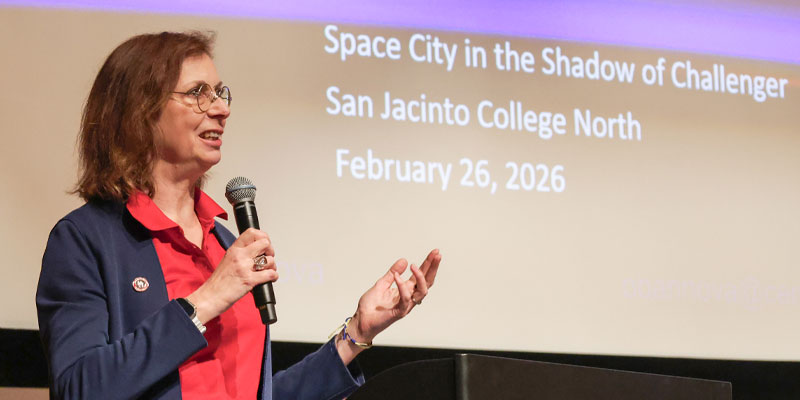
This year’s theme was “Space City in the Shadow of Challenger.” The chair, Dr. Alejandra Jaramillo-Fontenot, is a North Campus history professor.
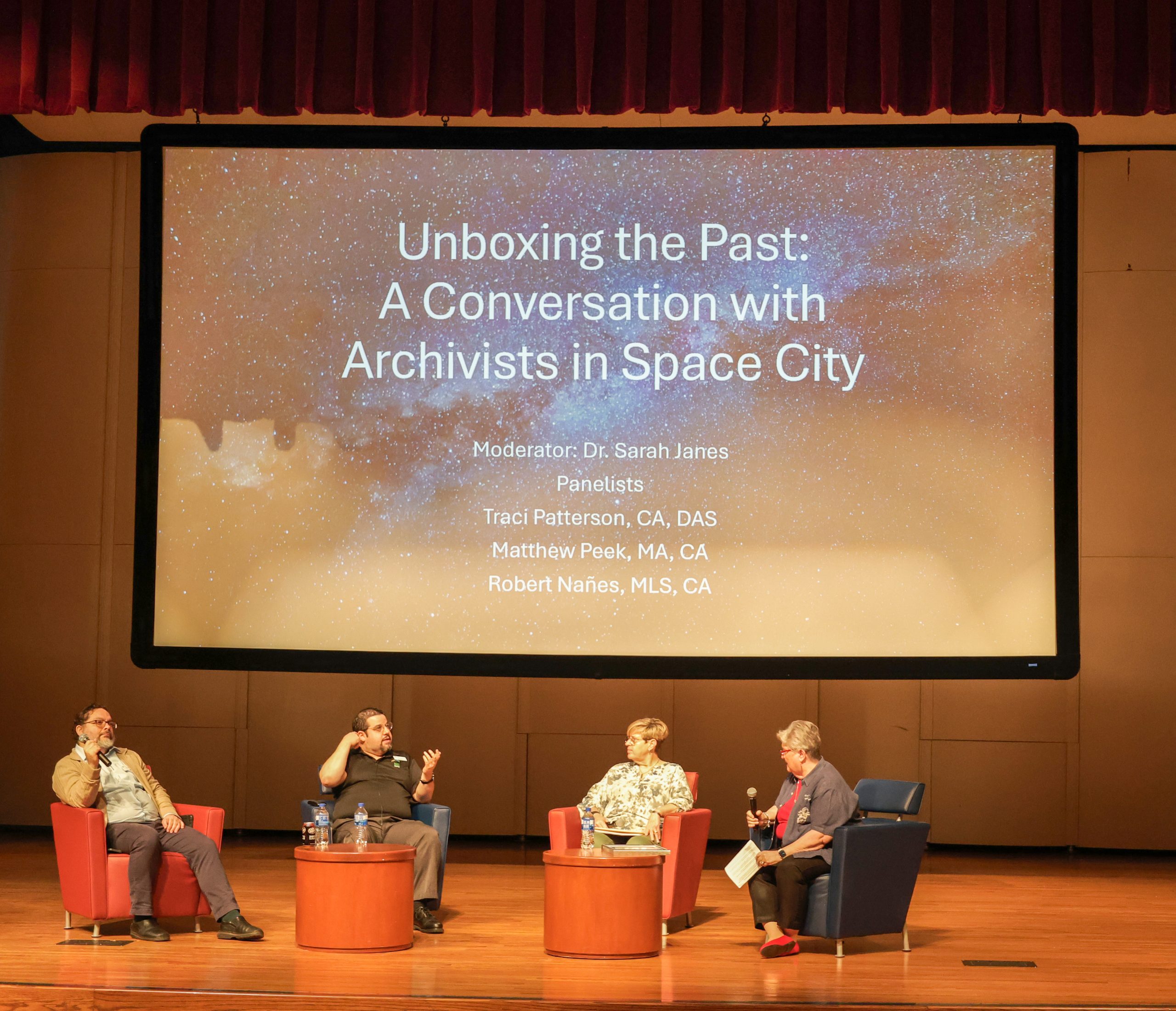
The program featured a mix of panel discussions and keynote presentations led by scholars from regional and national institutions. The agenda included a moderated panel:
- Dr. Sarah K. Janes (moderator), San Jac associate vice chancellor of continuing and professional development
- Matthew Peek, University of Houston-Clear Lake Archives and Special Collections associate director
- Robert Nañes, UHCL Archives and Special Collections archivist
- Traci Patterson, Rice University Woodson Research Center archivist/special collections librarian
The panel was followed by featured talks from:
- Dr. Olga Bannova, University of Houston director of the Space Architecture Graduate Program
- Dr. Moriba Jah, University of Texas at Austin Space Systems and Astrodynamics
“It’s designed to explore Houston’s connections to space history, culture, technology, and memory, especially in the context of the Space Shuttle Challenger disaster and its enduring legacy in education, innovation, and civic identity,” Gillespie said.
This year’s title reflects Houston’s longstanding identity as NASA’s ground zero for human space exploration, its achievements, tragedies, and how those experiences continue to influence scientific research, community engagement, and academic inquiry.
Keynote speaker
A National Geographic explorer, MacArthur Fellow, and internationally recognized leader in space science and decision intelligence, Jah focuses on improving the stewardship of Earth and the space environment through data-driven systems thinking. He has co-founded multiple space-focused ventures, including Privateer Space, GaiaVerse, and Moriba Jah Universal, and his research has been featured in Nature, Popular Science, and National Geographic.
Before joining academia, Jah served as a spacecraft navigator at NASA’s Jet Propulsion Laboratory, contributing to missions including Mars Global Surveyor, Mars Odyssey, Mars Exploration Rover, and Mars Reconnaissance Orbiter. He is a fellow of several prestigious scientific organizations and was recently recognized during Black History Month 2026 as an exceptional alumnus by Embry-Riddle Aeronautical University for his lasting impact on the aerospace industry.
Examples from past years
- 2025: “That 90’s Vibe” — presentations that explored 1990s culture in history, music, and social psychology
- 2024: “Hidden Histories: Things Your Teacher Didn’t Tell You”
- 2023: “Social Justice Movements: Community, Protest, and Inclusion”
- 2022: “Rethinking Borders: Identities, Cultures, and Ideas”
How does History Talks benefit students?
“We aim to expand learning beyond the classroom,” Gillespie said. “Students hear from regional and national scholars across disciplines, which broadens perspectives on how history intersects with culture, society, and current events.”
The goal is to introduce students to history as an academic discipline that students can pursue as a college major and possibly a career.
“We hope to encourage critical thinking and interdisciplinary thinking,” he said. “The interdisciplinary nature encourages students to think historically but also make connections to fields like psychology, sociology, and media studies. We want to show that knowledge is not confined to a particular course number.”
By Neesha Hosein